


At a technology strategy session in November 2026, the IT executive of a South African hospital group summed up a frustration we hear often. Once a year an external team runs a penetration test, the findings are fixed, the board is told the organisation looks sharp, and the box is ticked. “But a pen test is a point in time,” he said. The moment the testers leave, the environment changes again and nobody is checking.
He was right, and he was also clear that he did not want to give up independent testing. What he wanted was visibility in between: something that would tell his team, every week or month, when a server was unpatched or a new weakness had appeared.
That is the right way to think about penetration testing frequency. The question is not only how often to test, but how you stay informed between tests.
The short answer
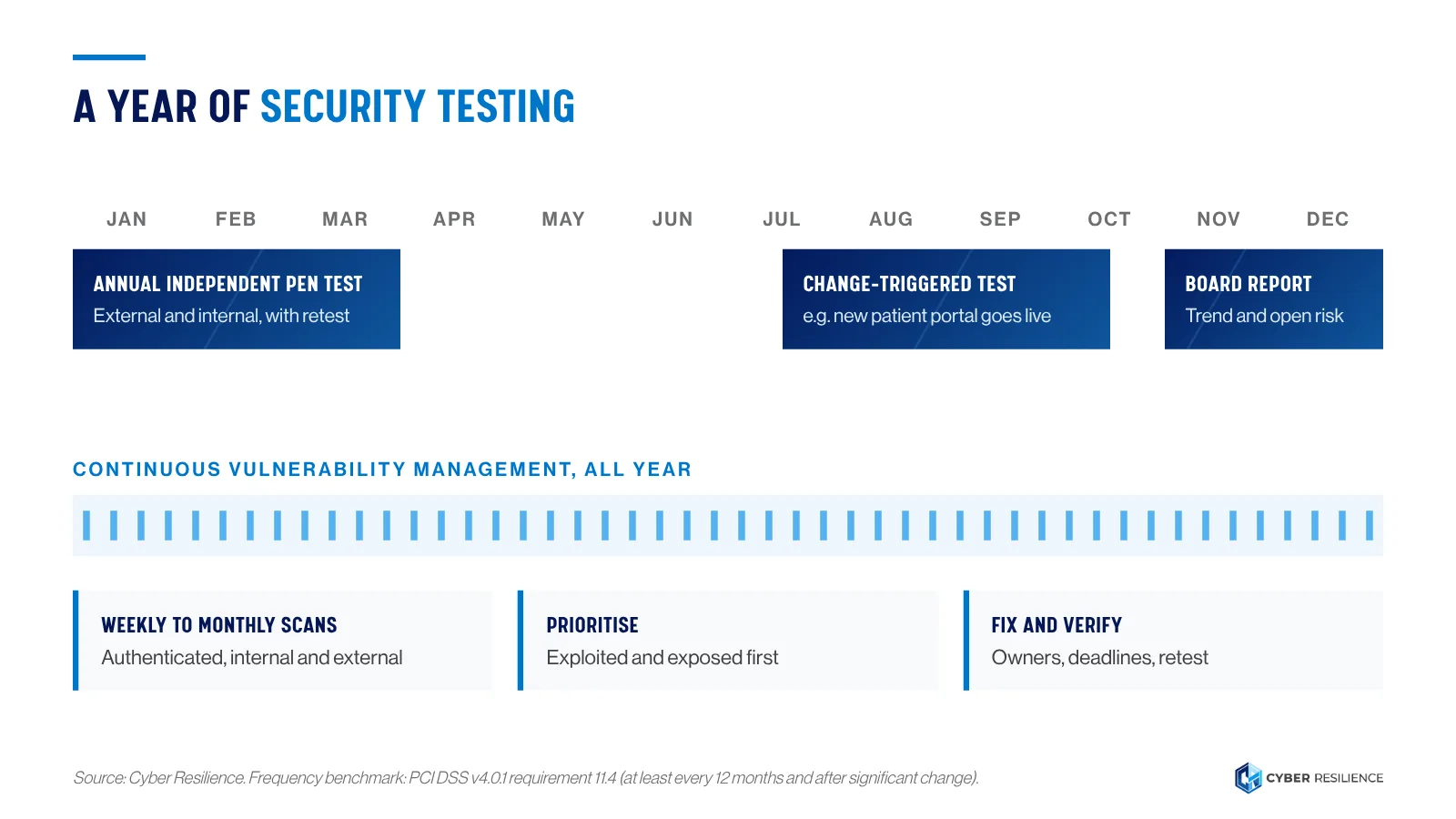
Most organisations should commission an independent penetration test at least once a year and after any significant change to systems, applications or network design. Internet-facing and high-value systems may need testing more often. Between tests, continuous vulnerability scanning and monitoring keep you informed of new weaknesses so they can be fixed before the next test, or an attacker, finds them.
Why once a year is no longer enough on its own
Attackers are moving faster than annual cycles. Mandiant’s M-Trends 2026 estimates the mean time to exploit a vulnerability is now minus seven days, meaning many vulnerabilities are exploited before a patch is available. Verizon’s 2026 Data Breach Investigations Report found that exploiting vulnerabilities has overtaken stolen credentials as the most common way into an organisation, at 31% of breaches.
A penetration test remains the best way to find out what an attacker could actually achieve in your environment. It simply cannot tell you about the vulnerability published the week after the testers leave.
How often should you test?
A useful benchmark comes from the payment card industry. PCI DSS v4.0.1 (requirement 11.4) requires internal and external penetration tests at least once every 12 months and after any significant infrastructure or application change. Even if PCI DSS does not apply to you, that combination of a calendar floor plus change-based triggers is sound practice.
Changes that should trigger a test
- A new internet-facing application, portal or API
- Migration of critical systems to the cloud, or a new hosting provider
- Major changes to network design, segmentation or remote access
- A merger, acquisition or new subsidiary joining the network
- After a significant security incident, once remediation is complete
- New client, regulator or insurer requirements
When to test more often
Consider six-monthly or quarterly testing for systems that are internet-facing, hold sensitive personal or financial data, or change frequently. Application tests should follow major releases.
Penetration test, vulnerability assessment or continuous vulnerability management?
These are often confused, and they answer different questions. Our article on vulnerability assessment services covers the assessment side in more detail.
| Penetration test | Vulnerability assessment | Continuous vulnerability management | |
|---|---|---|---|
| Question it answers | What could an attacker actually achieve? | Which known weaknesses exist right now? | Are new weaknesses being found and fixed on time? |
| Method | Skilled testers chain weaknesses together, manually and with tools | Mostly automated scanning, validated by an analyst | Scheduled authenticated scanning, prioritisation, remediation tracking and retest |
| Typical frequency | Annually and after major change | Point in time, often quarterly | Weekly to monthly, ongoing |
| Output | Exploited attack paths, business impact, prioritised fixes | List of vulnerabilities with severity | Trend of open risk, overdue fixes, coverage |
| Independence | Should be independent of the team being tested | Can be internal or external | Usually internal or managed service |
What should happen between tests
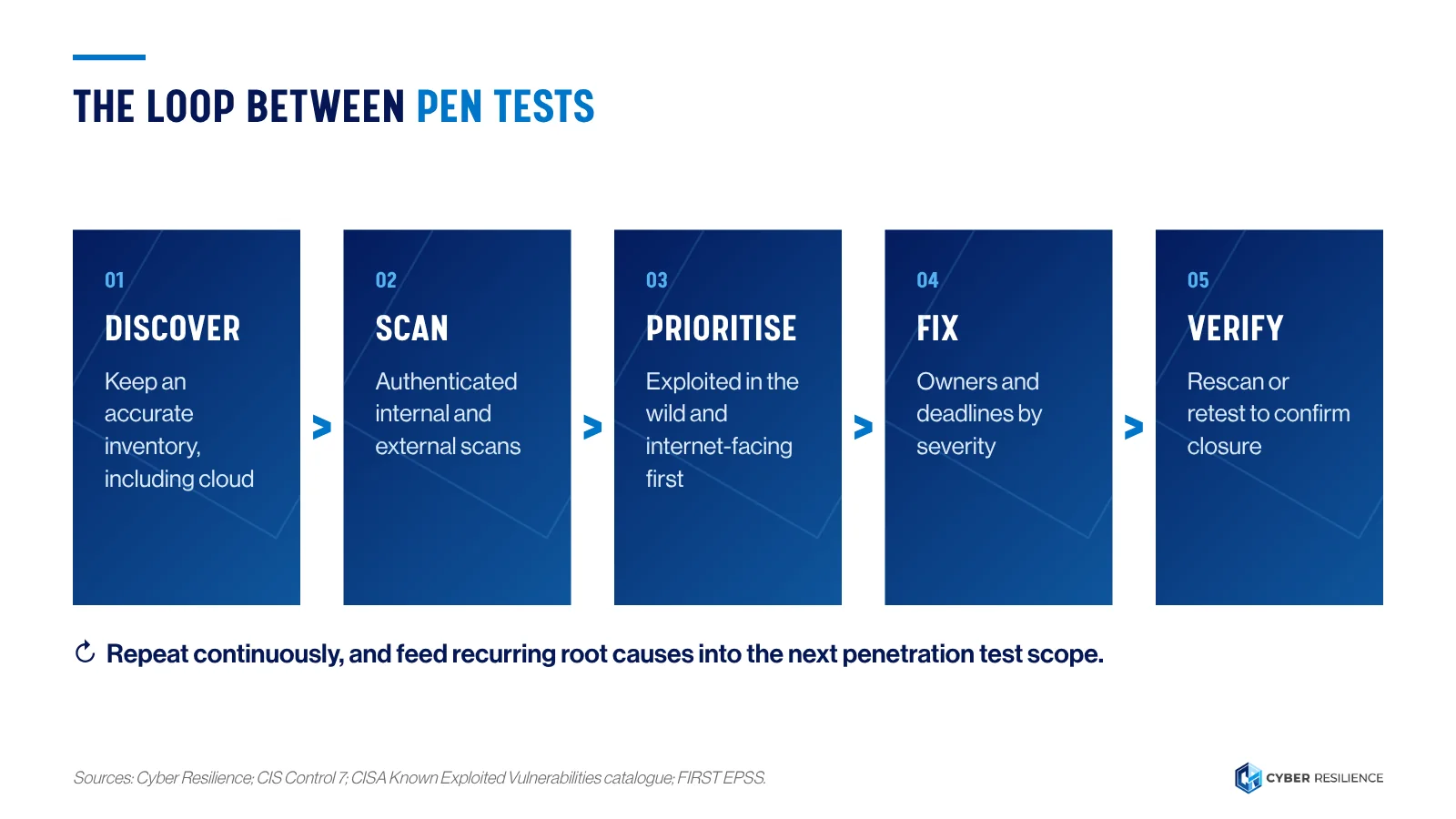
- Know what you own. You cannot scan what you have not inventoried. Keep an up-to-date list of internet-facing and internal assets, including cloud services.
- Scan inside, not only outside. Authenticated internal scans find the missing patches and weak configurations that attackers use to move once they are in.
- Prioritise by exploitability, not score alone. Use the severity score as a starting point, then raise anything listed in CISA’s Known Exploited Vulnerabilities catalogue or with a high EPSS exploit-probability score, especially on internet-facing systems.
- Give the fixers the findings. Remediation stalls when results sit with one team and the fix with another.
- Track to closure and retest. Agree fix timeframes by severity and report what is overdue.
- Watch for exploitation. Monitoring through a SOC catches attempts to use weaknesses you have not fixed yet.
“If the IT team doesn’t have direct access to the vulnerability scan results, the mitigation effort generally falls short. The people fixing things need to see what’s wrong and confirm they’ve actually fixed it.”
Qurash Ramlal, Customer Success Manager, Cyber Resilience
This is what frameworks expect as well. CIS Control 7 calls for continuous vulnerability management, and ISO/IEC 27001:2022 includes the management of technical vulnerabilities among its Annex A controls.
Getting more value from each penetration test
- Scope it properly. Agree rules of engagement covering in-scope ranges, applications, testing windows and exclusions before testing starts.
- Test both perspectives. External tests show what the internet sees; internal tests show what happens after a phishing click or a compromised supplier account.
- Fix, then retest. A finding is only closed when a retest confirms it.
- Look for root causes. If the same misconfiguration appears every year, the problem is a process, not a server.
- Keep the tester independent. Internal scanning complements an independent test; it does not replace it.
Where Cyber Resilience fits
Our testing team began as forensic investigators, so findings are validated, prioritised and written for both the technical team and the board. We run penetration testing and vulnerability assessments, and provide ongoing vulnerability management supported by our TOTALIS platform, which ranks vulnerabilities using CVSS, EPSS and VPR and tracks each fix to closure.
Next step: Ask us to review your testing programme. We will suggest a cycle of independent testing and continuous scanning that fits your risk and budget.
Key takeaways
- Test at least annually and after significant change; test high-value, internet-facing systems more often.
- A penetration test is a snapshot. Continuous vulnerability management keeps you informed in between.
- Prioritise by real-world exploitability and give the people fixing issues direct access to findings.