

The short answer
An in-house SOC offers direct control but requires ongoing staffing, technology and specialist investment. SOC as a Service supplies contracted capabilities; co-managed SOCs share responsibilities. Compare actual monitoring scope, response authority, total cost and evidence of outcomes before choosing.
Start with the decision you actually need to make
Should you build a Security Operations Centre, outsource it or combine internal and external capabilities? There is no universal winner. The best model gives your organisation the visibility, investigation capacity, and response authority you need at a sustainable cost and effort level.
This guide helps you define requirements before asking providers for proposals. Use it with your IT, security, risk, procurement and finance stakeholders.
The three operating models
In-house SOC
Your organisation recruits, manages and develops its own analysts, engineers and response processes. This can provide deep institutional knowledge and direct control, but continuous coverage and specialist depth require long-term investment.
SOC as a Service
A provider supplies defined monitoring and investigation capabilities under contract. The organisation still owns risk and decisions, and must understand exactly what the provider will and will not do.
Co-managed SOC
Your internal team retains security leadership and business context, while a partner provides selected coverage, investigation or engineering services. This can be especially useful where the team is capable but cannot staff every shift.
Compare models against your needs
- Coverage: Can the model deliver the hours you need with genuine analyst availability?
- Expertise: Who handles complex investigations?
- Visibility: Which systems are integrated?
- Authority: Who may contain an incident?
- Governance: Where is data stored and who has access?
- Sustainability: Can you maintain the model for three to five years?
Do not assume that outsourced always means 24/7, or that in-house always means better visibility. These are scope and design questions.
What should your SOC monitor?
Start with business-critical assets and plausible attack paths. Typical telemetry domains include identity, endpoints, servers, cloud platforms, network controls and existing security tools. Ask what is covered today and what will remain a blind spot.
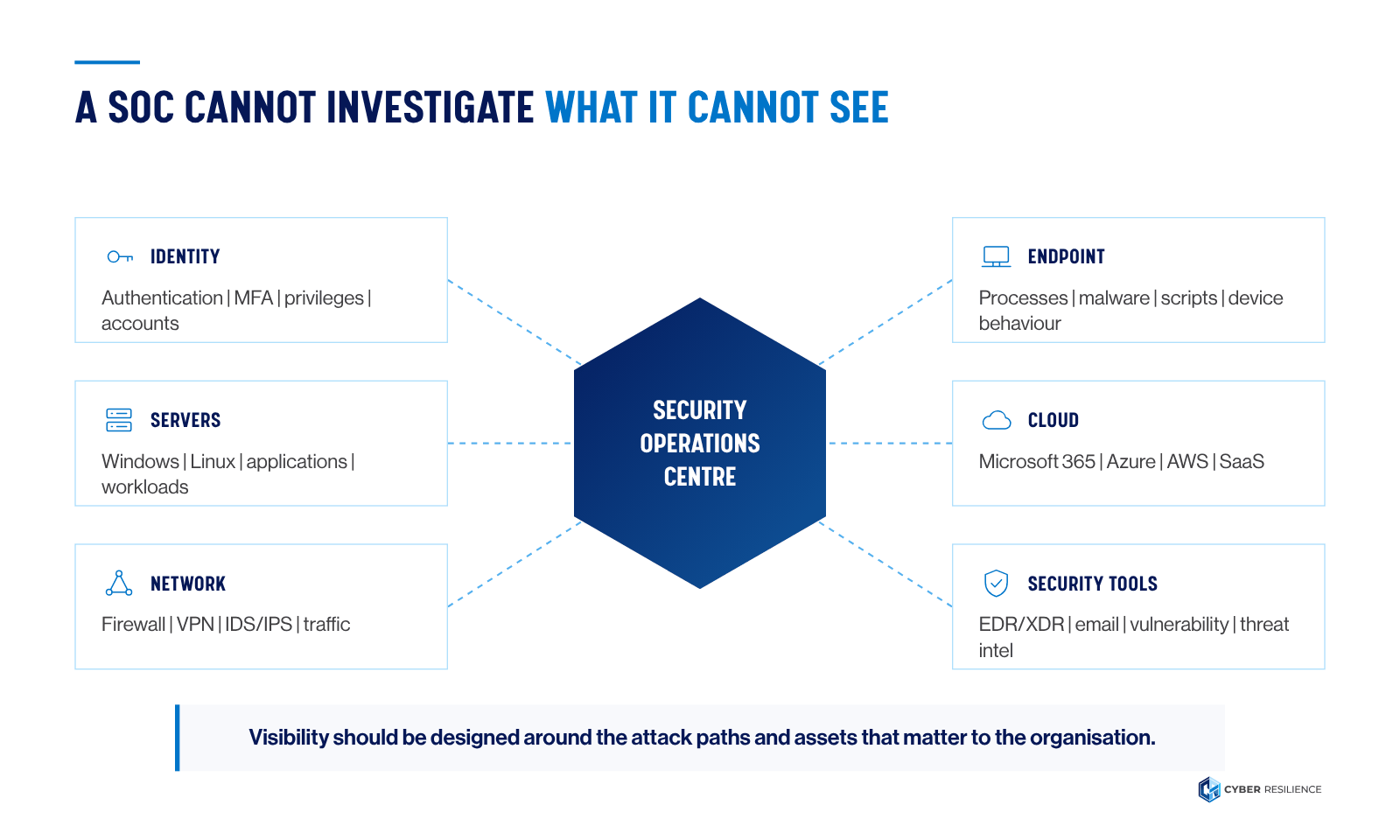
For example, a SOC that sees endpoint malware alerts but not privileged identity changes may miss important context. A long list of log sources is less meaningful than coverage of the risks that matter to your organisation.
What should happen when an alert fires?
Ask the provider to walk through a realistic scenario from the first signal to the final case note. Who performs Tier 1 triage? What triggers Tier 2 investigation? What evidence is collected? When are you notified? What actions require approval?
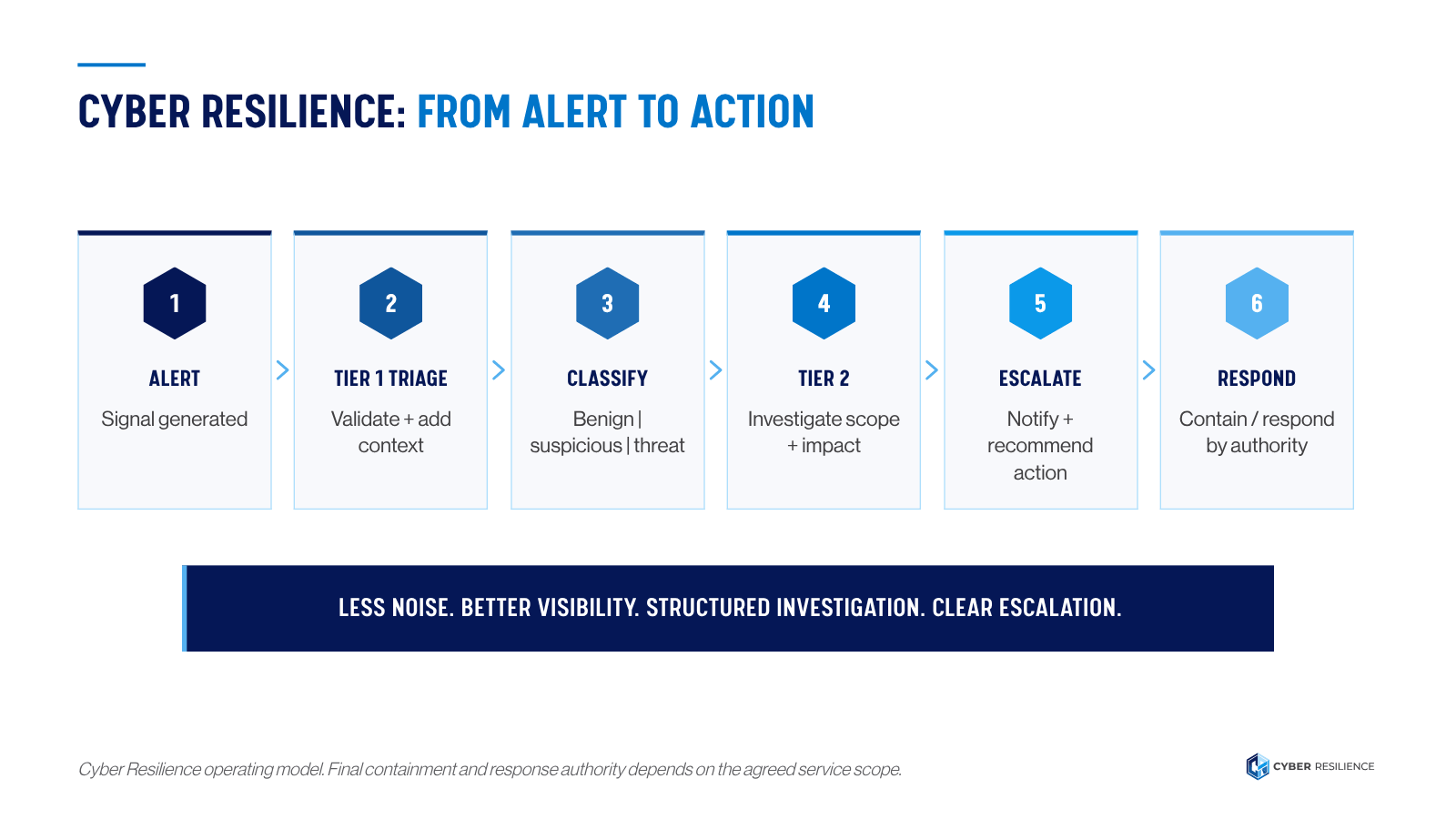
A mature process should distinguish notification from investigation, and investigation from containment. Each may have a different SLA and owner.
Build a fair three-to-five-year cost comparison
For an internal SOC, include salaries, shift and leave coverage, recruitment, training, specialist escalation, SIEM and other licensing, log storage, case management, engineering and management. For a managed service, include onboarding, integrations, subscription scope, additional telemetry, out-of-hours incident response and internal oversight.
Finance should compare equivalent capability, not a provider invoice against the salary of one analyst. Document assumptions rather than presenting speculative savings as fact.
Nine questions to ask before signing
- What exact assets, identities, systems and data sources will you monitor?
- Which existing technologies can you integrate, and what additional products are required?
- Who investigates alerts, at which tiers, and from which locations?
- Is the contracted service staffed by analysts 24/7/365, or only the tooling?
- What happens after an alert: forwarding, triage, investigation or response?
- What are the severity definitions and triage, escalation and response SLAs?
- What containment actions can you take, and whose approval is required?
- Where is data stored, processed and accessed, and what retention and subprocessor terms apply?
- How will you demonstrate improvements in detection coverage and response outcomes?
Ask for evidence: a scope inventory, integration plan, anonymised investigation output, escalation matrix, data-processing terms and example management report. A polished dashboard alone is not enough.
How to evaluate the answers
A strong response is specific about inclusions, exclusions, ownership and evidence. A weak response substitutes phrases such as ‘fully protected’ or ‘AI-powered’ for the actual operating process. Score suppliers against your priorities and make critical requirements pass/fail where appropriate.
Consider a short technical workshop using a representative scenario. Have the prospective provider explain what telemetry it would need, what it could determine, when it would escalate and what would happen if the internal contact were unavailable.
Data governance and POPIA
SOC telemetry may contain personal information. Clarify cross-border access, retention, access controls, subcontractors, deletion and breach notification. POPIA section 72 permits cross-border transfers under specified conditions; it does not create a universal local-hosting requirement. Obtain legal review for your circumstances.
Before you choose: seven questions worth discussing internally
A good provider evaluation starts before the first sales meeting. The answers do not need to sit in a formal worksheet, but your IT, security, risk and business leaders should have a shared view of what they need the SOC to achieve.
Which systems matter most?
Consider the identities, business applications, cloud services and operational systems whose compromise would have the greatest effect on customers, operations or compliance. These should inform monitoring priorities.
When do you need coverage?
Think about what happens outside business hours, on weekends and when key employees are unavailable. Who receives a critical escalation, and who can make a decision?
Where are the visibility gaps?
Your existing tools may generate plenty of alerts without giving analysts enough context. Which events cannot currently be correlated or investigated with confidence?
Who is authorised to act?
Decide which actions require approval, such as disabling an account or isolating a device, and how urgent incidents will be handled if the usual contact cannot be reached.
What does useful reporting look like?
Go beyond the number of alerts. Consider investigation quality, detection coverage, escalation performance, recurring weaknesses and evidence of improvement.
What requirements are non-negotiable?
Identify any regulatory, contractual, data-access, retention and cross-border processing requirements that could rule out an otherwise attractive option.
Which operating model is realistic for your team?
An internal SOC, SOC as a Service and a co-managed approach can all be effective. The better choice is the one your organisation can operate, govern and sustain.
These questions are useful conversation prompts, not a scoring exercise. They help reveal where a proposed service fits your actual environment and where assumptions still need to be tested.
Where Cyber Resilience fits
Cyber Resilience’s stated SOC process covers alert intake, Tier 1 triage, classification, Tier 2 investigation and escalation or response according to the agreed service scope. Discuss your existing technology, business-critical risks, internal team capacity and authority model before choosing a service design.
Next step: Request a conversation about your SOC operating model. Bring your current security-tool inventory and an outline of your incident escalation process.
Key Takeaways
- Compare in-house, outsourced and co-managed options against the same required capability.
- Request evidence of monitoring scope, analyst coverage, escalation and response authority.
- Use a multi-year cost model and measurable outcomes, not alert counts alone.